

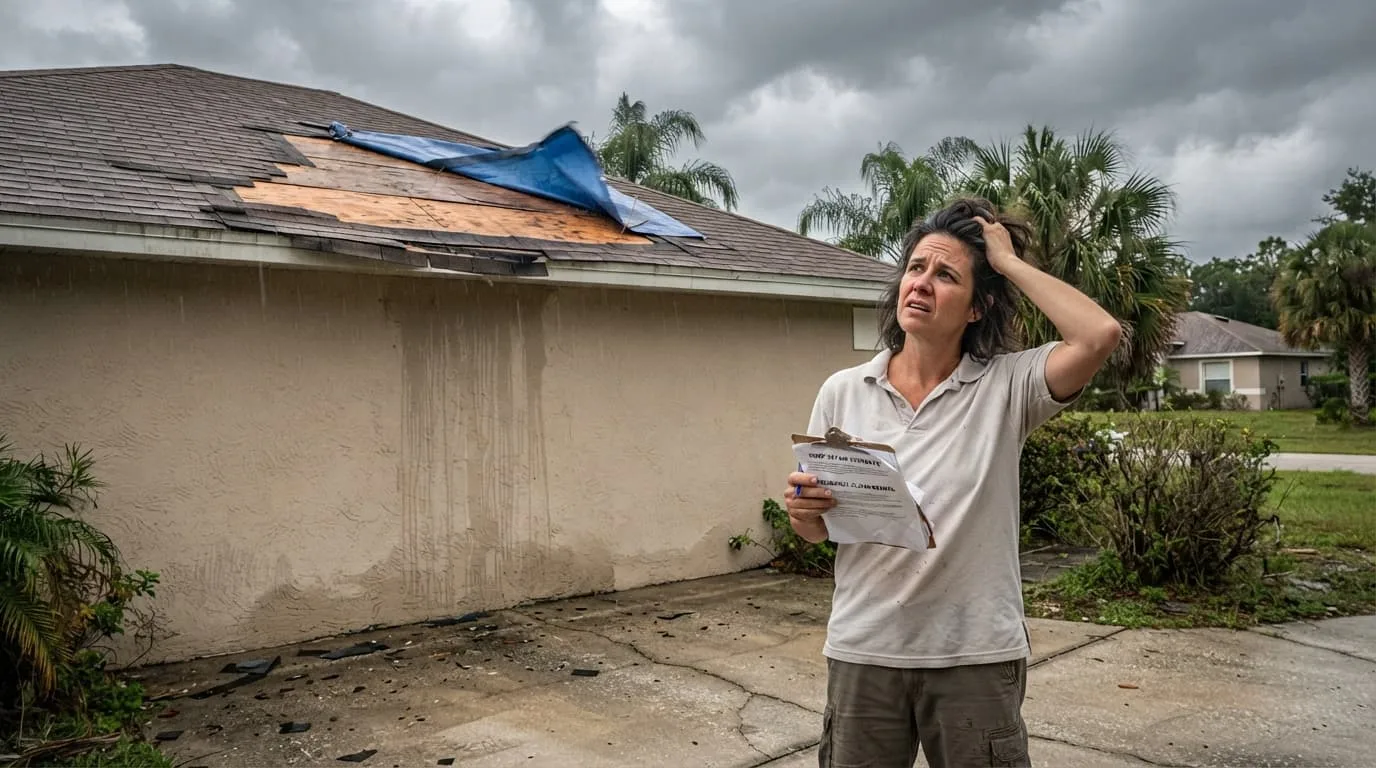
Hurricane Isaias generated approximately 55,000 residential property claims in Florida, with early estimated insured losses reaching $651 million. But the storm has also brought attention to another issue: Florida’s deadline for filing a new property insurance claim.
For Central Florida homeowners, the time to inspect storm damage, review policy requirements, and document roof problems matters. A missed deadline or poorly supported claim can create avoidable complications. Here is what the latest data reveals and how homeowners can make informed decisions before time runs out.
Key Statistics on Hurricane Isaias Aftermath: Florida’s 1-Year Roof Claim Deadline
The figures below show the scale of Isaias-related claims, the reasons some claims close without payment, and the financial pressures facing Florida homeowners. Claim totals and loss estimates can change as insurers update their reports.
- Approximately 55,000 residential property claims - Florida had received about 55,000 claims within two weeks of the storm.
- $651 million in estimated insured losses - Early insurer reports put Florida’s estimated losses at this level.
- 22% of claims closed by October 20 - Many of these early closures involved claims with no payment.
- 1 year from the date of loss - Florida law generally gives policyholders one year to file an initial property insurance claim.
- 18 months from the date of loss - The general deadline for filing a supplemental property insurance claim.
- Approximately $3 billion in insured losses - Karen Clark & Company estimated losses across the Southeastern United States.
- Administrative reasons - This was the most frequently cited category for no-payment closures in the early reporting.
- 7.6% of Florida permits - Re-roofing permits accounted for this share of permits in the third quarter of 2026, according to Carbon Arc’s analysis.
- 47% of Florida homeowners - This share of surveyed homeowners reported premium increases of at least 50% over five years.
- 53% of homeowners who filed claims - This share reported premium increases of at least 50% over the same period.
Why Did Hurricane Isaias Generate Approximately 55,000 Florida Insurance Claims?
Hurricane Isaias generated about 55,000 residential property claims in Florida within two weeks of its October 9, 2026, landfall. The volume reflects damage across a wide area, particularly in the western Panhandle.
For homeowners, storm damage is not always obvious from the ground. High winds can loosen asphalt shingles, damage flashing, lift roof edges, and allow water to enter the attic. Falling branches can also damage roof coverings or gutters.
A roof inspection can help identify problems such as:
- Missing, cracked, or lifted shingles.
- Damaged flashing around vents and chimneys.
- Loose or displaced metal roofing panels.
- Water stains on ceilings and attic surfaces.
- Damaged gutters and roof drainage components.
These claims do not all represent complete roof failures. Some involve limited repairs, while others require more extensive work. Homeowners should have visible and suspected damage assessed before deciding what work is necessary or whether to contact their insurance companies.
How Did Hurricane Isaias Cause $651 Million in Insured Losses in Florida?
Early reports placed Hurricane Isaias’s estimated insured losses in Florida at approximately $651 million. This figure represents reported insured losses at that point in the claims process, not the storm’s complete economic cost.
Roof damage can lead to expenses beyond replacing shingles or metal panels. Water entering through damaged roofing materials may affect insulation, drywall, flooring, electrical components, and personal belongings. Wind-driven rain can also expose weak points around roof penetrations and flashing.
The final cost depends on the extent of the damage, the property type, the policy, and the repair requirements. A documented roof inspection helps establish the condition of the roof and identifies work that may be needed.
Homeowners should keep dated photographs, inspection findings, repair estimates, invoices, and communications with their insurer. These records can help explain the damage and support a clearer review of the claim.
Why Were 22% of Hurricane Isaias Claims Closed Without Payment?
About 22% of Isaias claims had been closed by October 20, and many early closures involved no payment. A claim closed without payment does not automatically mean an insurer rejected valid storm damage.
The Florida Office of Insurance Regulation’s reporting categories include administrative reasons, damage below the policy deductible, and damage that falls outside the policy’s coverage. Some homeowners also withdraw claims after learning that the damage is less costly than expected.
This distinction matters. A homeowner may report a fallen tree, for example, before confirming whether it damaged the insured structure. A roof inspection and repair estimate can help establish whether there is actual covered property damage and whether the estimated cost exceeds the deductible.
Before filing, homeowners should:
- Review the policy’s deductible and relevant exclusions.
- Photograph visible damage and record when it occurred.
- Obtain a qualified roof inspection when damage is suspected.
- Keep copies of all insurer communications.
- Respond promptly to reasonable requests for information.
No contractor can guarantee an insurer will approve a claim. The insurer makes that decision under the policy.
How Long Do Florida Homeowners Have to File a New Roof Insurance Claim?
Florida law generally gives homeowners one year from the date of loss to notify their insurer about a new property insurance claim. For a hurricane, the date of loss is the date the storm makes landfall, not the day a homeowner later discovers roof damage.
Florida Statutes §627.70132 sets this deadline for claims under property insurance policies. The law also defines a separate period for supplemental claims, which should not be confused with the initial filing deadline.
For Isaias, which made landfall on October 9, 2026, the general one-year deadline points to October 9, 2027. Homeowners should not wait until the final weeks to investigate possible damage.
A practical timeline includes:
- Soon after the storm: Photograph visible damage and arrange an inspection.
- During the first few months: Review the policy, deductible, and inspection findings.
- Before the one-year mark: Give the insurer notice in line with the policy and legal requirements.
Policy terms and individual circumstances can affect a claim. Homeowners should confirm their specific deadline with their insurer or a qualified Florida insurance attorney.
Why Do Florida Supplemental Roof Insurance Claims Have an 18-Month Deadline?
Florida law generally gives policyholders 18 months from the date of loss to notify the insurer of a supplemental property insurance claim. This applies when a timely initial claim has already been reported and additional damage or costs from the same event emerge.
A supplemental claim is not a way to extend the time for filing a new claim. Under the statute, it concerns additional loss or damage from the same event that the insurer has previously adjusted, or costs incurred while completing repairs or replacement under an open claim.
| Claim type | General deadline | What it covers |
|---|---|---|
| New claim | 1 year | Initial notice of property damage |
| Reopened claim | 1 year | Request to reopen a previously closed claim |
| Supplemental claim | 18 months | Additional damage or costs tied to a previously reported loss |
For example, a roofer may find additional damage while removing storm-damaged shingles during an approved repair. The homeowner may need to notify the insurer about those additional costs within the supplemental claim period.
Keep inspection reports, photographs, invoices, and repair records. These documents help explain why additional work became necessary.
How Did Hurricane Isaias Generate Nearly $3 Billion in Southeastern U.S. Insured Losses?
Karen Clark & Company estimated approximately $3 billion in privately insured losses across the Southeastern United States from Hurricane Isaias. Its estimate covered wind and storm surge damage across residential, commercial, and industrial properties, as well as certain other insured losses.
The regional estimate is broader than Florida’s early reported figure of $651 million. The two numbers measure different geographic scopes and reporting stages, so they should not be treated as competing estimates.
For property owners, the wider loss figure shows how a hurricane can affect many types of buildings and businesses. A damaged roof can interrupt business operations, expose inventory, and create repair costs beyond the roof itself.
Residential and commercial properties may also require different roofing materials and repair methods. Asphalt shingles are common on homes, while commercial buildings may use flat roofs, modified bitumen, or Thermoplastic Polyolefin (TPO) systems.
The right repair plan depends on the roof design, damage, and applicable building requirements. A professional inspection should identify the affected materials and the work needed to restore the roof.
Why Were Administrative Reasons the Most Common Category for No-Payment Claim Closures?
Administrative reasons were the most frequently cited category for no-payment claim closures in the early Isaias reporting. The category can include withdrawn claims, duplicate filings, incorrect information, and cases where the insurer could not communicate with the policyholder.
This category does not mean every affected homeowner had a valid claim rejected. It also does not mean administrative problems were the only reason claims closed without payment. Some claims involved damage below the deductible or losses outside the policy’s coverage.
Homeowners can reduce avoidable confusion by taking a few basic steps:
- Confirm the date and location of the reported damage.
- Keep a copy of the claim number and all submitted documents.
- Avoid opening duplicate claims for the same loss.
- Respond to reasonable requests from the insurer.
- Keep written records of calls, emails, inspections, and estimates.
A roofing contractor can document visible roof conditions and prepare a repair estimate. However, the insurer determines coverage under the policy, and contractors should not promise a particular claim outcome.
Why Did Florida Re-Roof Permits Fall to 7.6% in Q3 2026?
Re-roofing accounted for 7.6% of Florida permits in the third quarter of 2026, according to Carbon Arc’s analysis. The share was reported as the lowest since the period before Hurricane Irma in 2017.
This figure deserves attention, but it needs careful interpretation. Permit share measures re-roofing permits against all permits in the dataset. It does not directly show how many roofs need repairs, how many homeowners postponed work, or how much storm damage exists.
Several factors may influence whether a homeowner proceeds with a roof replacement:
- The cost of roofing materials and labor.
- Insurance deductibles and coverage decisions.
- Financing availability and household budgets.
- Whether damage requires immediate work or can be monitored.
- Local permit requirements and contractor availability.
A lower permit share could reflect delayed projects, changes in construction activity, or other market conditions. It should not be treated as proof that Florida homeowners are ignoring roof damage.
Still, delaying necessary repairs can allow water intrusion to affect insulation, ceilings, and other parts of a building. Homeowners should address active leaks and documented storm damage promptly, even when a full roof replacement is not immediately necessary.
Why Did 47% of Florida Homeowners Report Premium Increases of 50% or More?
A University of North Florida survey found that 47% of surveyed Florida homeowners who had lived in their homes for at least five years reported premium increases of 50% or more during that period. The result highlights the pressure many households feel from rising insurance costs.
Insurance premiums can change for several reasons, including the insurer’s costs, reinsurance prices, property risk, repair expenses, and conditions in the wider insurance market. A homeowner’s roof age and condition may also be relevant to underwriting decisions.
However, the survey records what respondents reported. It does not establish that one specific event, roof condition, or insurance claim caused an individual homeowner’s premium to rise.
The survey was conducted by the University of North Florida’s Public Opinion Research Lab. Its findings are useful for understanding homeowner experiences, but they should be read as survey results rather than a complete measure of every Florida insurance policy.
For homeowners considering roof repairs or replacement, the practical priority is to understand the property’s condition and keep accurate records of completed work. A new roof does not guarantee a premium reduction, so ask the insurer whether specific improvements qualify for any policy credits.
Why Did 53% of Florida Homeowners Who Filed Claims Report Premium Increases of 50% or More?
The UNF survey found that 53% of homeowners who had filed an insurance claim reported premium increases of at least 50% over five years. This was higher than the 47% reported among the broader group of homeowners who had lived in their homes for at least five years.
The difference may concern homeowners who are deciding whether to report storm damage. However, the survey does not prove that filing a claim caused the increase. Premiums can rise for many reasons, and the survey relies on respondents’ reports rather than a controlled comparison of individual insurance records.
The finding should not encourage homeowners to ignore legitimate damage. A roof leak can worsen over time, leading to more expensive repairs and damage inside the property.
Instead, homeowners should make informed decisions based on:
- The extent and likely cause of the damage.
- The policy’s deductible and coverage terms.
- A qualified inspection and written repair estimate.
- The insurer’s reporting requirements.
- The potential cost of delaying necessary repairs.
A well-documented claim gives the insurer clearer information to review. It cannot guarantee approval or prevent future premium changes.
How Can Central Florida Homeowners Protect Their Roof Insurance Claims Before the Deadline?
Homeowners can protect their position by arranging an inspection, documenting storm damage, reviewing policy requirements, and notifying the insurer within the applicable deadline. Taking these steps early gives them more time to gather information and address problems.
Start with a visual record. Photograph missing shingles, damaged flashing, fallen branches, water stains, and other signs of damage. Take pictures from safe locations and avoid climbing onto a roof.
Next, arrange a professional roof inspection. A roofing contractor can assess the visible condition, identify areas that may need repair, and prepare an estimate. Keep the inspection report with dated photographs and any repair invoices.
Before filing, check the policy’s:
- Hurricane or windstorm deductible.
- Coverage limits and exclusions.
- Requirements for reporting damage.
- Duties to prevent further damage.
- Documentation and inspection requirements.
Homeowners should also keep receipts for reasonable temporary measures, such as emergency roof coverings, where appropriate. These records may help explain what happened after the storm.
FAQ
What Should I Do First If a Storm Damages My Roof?
When a storm damages your roof, take photos from the ground and move furniture away from active leaks. Do not climb onto wet or unstable roofing materials. Place a bucket under dripping water and cover belongings with plastic.
Contact a roofing contractor in Lakeland to arrange an inspection. If water reaches electrical fixtures, avoid the area and call an electrician.
How Often Should I Schedule a Roof Inspection in Lakeland?
A roof inspection can identify loose shingles, cracked flashing, lifted roof edges, clogged gutters, and soft decking before they cause interior leaks. Ask the inspector to check the attic for damp insulation, water stains, and daylight around roof openings.
After severe storms in Central Florida, schedule an inspection even when damage is not visible from the ground and roof valleys.
What Should I Check Before Hiring a Roofing Company?
Before signing a roofing project agreement, ask which roofing materials the contractor will install and what the estimate includes. Confirm costs for removing old materials, replacing damaged decking, permits, cleanup, and unexpected repairs.
Request the project schedule and written labor warranty. Also ask whether the manufacturer warranty covers the selected shingles or metal roofing materials. Confirm payment terms before signing.
Will My Homeowners Insurance Cover Roof Repairs After Storm Damage?
Homeowners insurance may cover roof repairs when damage results from a covered event, but the policy determines what qualifies. Photograph damaged areas from the ground, prevent further water entry with temporary protection, and contact your insurer promptly.
Ask the roofing contractor for an inspection report and itemized estimate. Keep receipts for emergency work and temporary repairs. Save them safely, too.
When Should I Consider Roof Replacement Instead of More Repairs?
Consider roof replacement when leaks return after repairs, shingles are missing across large areas, or the roof deck has widespread damage. Ask a roofing contractor to compare the cost of further repairs with replacement.
Discuss asphalt shingles, metal roofing, underlayment, ventilation, and wind mitigation features. Check material warranties and labor coverage before approving the project in Lakeland.
What Should Central Florida Homeowners Do Before Florida’s 1-Year Roof Claim Deadline?
If your roof may have storm damage, don’t wait until the last minute to get it checked. Florida generally gives homeowners one year from the date of loss to report a new or reopened property insurance claim. For Hurricane Isaias, that points to October 9, 2027. Supplemental claims have a separate 18-month deadline.
Arrange a roof inspection, document visible damage, and review your policy before filing. True Roofers can help assess storm damage and plan roof repairs in Lakeland and nearby areas. Contact True Roofers to discuss your roof and request an inspection.
A shorter version is Roof Repair Lakeland Deadline Looms as 22% of Isaias Claims Closed Unpaid.
