

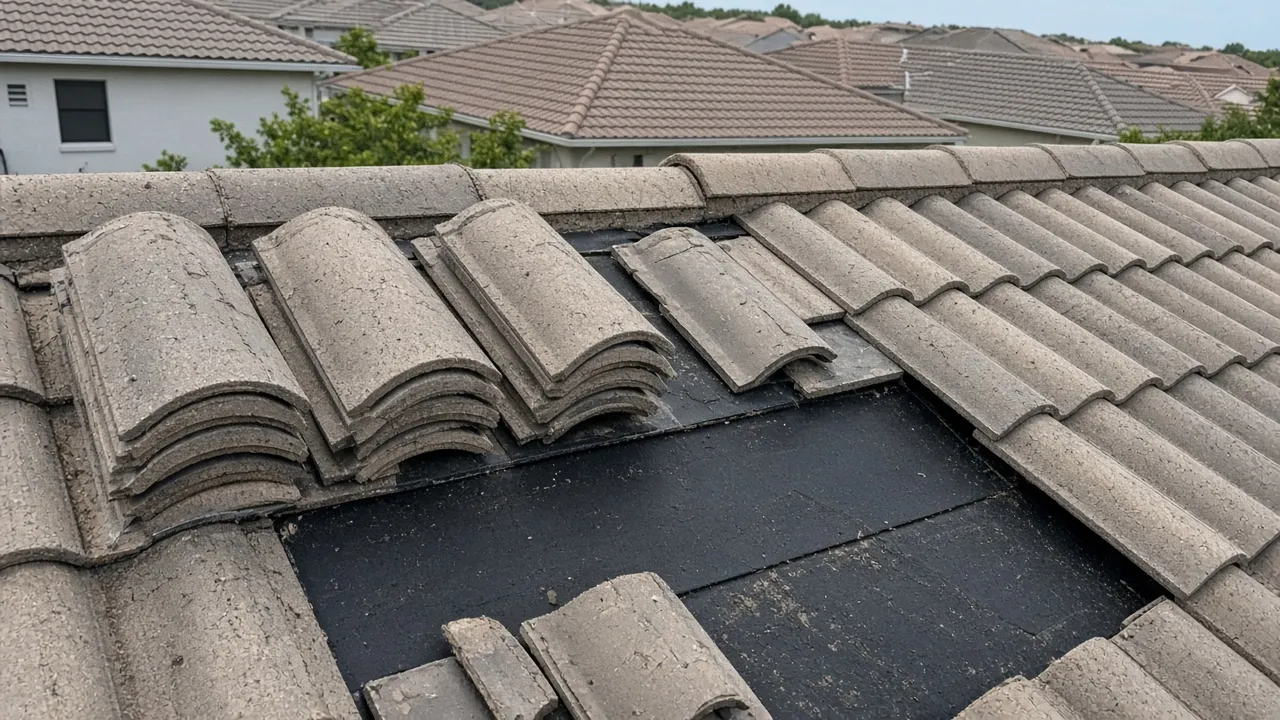
Clay and concrete tile on a Florida house often stays up for decades. The underlayment under it usually fails first. That is the useful answer to how long a tile roof lasts in Florida. The tile you see from the street is the armor. The sheet under it is what keeps rain out of the deck.
True Roofers works these roofs in Lakeland, Plant City, Winter Haven, Wesley Chapel, Auburndale, and Davenport. License CCC1332725. We photograph what we find. We do not file the claim and we do not adjust it.
What decades means on a tile roof
People ask for a single year. A clay tile and a concrete tile do not share one expiration date, and a roof in full sun on a Lakeland ridge ages differently from a shaded slope. What we can say from the roofs we open is this: the tiles are often still in place, and still mostly whole, when the layer beneath them has cracked, dried out, or pulled back at the laps.
That layer is the underlayment. It is the waterproof sheet between the tile and the wood deck. Florida heat works on it every day the tile is soaking up sun. You can have a roof that looks orderly from the driveway and a deck that is already taking water at the hips, the valleys, or a single slipped tile.
So the lifespan question splits in two. How long do the tiles last? Often decades, if they are not cracked across the field and the profile is still made. How long does the roof keep water out? Only as long as the underlayment, the flashing, and the fastening of each tile are doing their jobs. Those parts are on a shorter clock than the tile.
Clay tile and concrete tile
The tile roofs we repair in Central Florida are clay and concrete. Clay is the thinner, often curved piece. Concrete is heavier and shows up on a lot of subdivision houses. Both sit on battens or directly over the underlayment, depending on how the roof was built. We do not claim every imported profile or every mortar-set detail. If a tile has been discontinued and we cannot match it, that fact goes in the inspection notes before anyone starts pulling the field apart.
One job is on camera. The crew tore a ceramic tile roof off and installed a Permatile system because the owner wanted a different look. The material arrived the day before the walk-through. The tear-off went to the deck. That is the moment rotten sheathing shows up, which is why a tile changeover is not a surface swap. The video is ceramic tile to Permatile. The service page is tile roof repair.
What fails before the tile does
Underlayment is the common one. It gets brittle. It splits at the laps. It disappears in patches under tiles that still look fine. When we lift a tile for a “simple” repair and the sheet under it crumbles, the repair stops being simple.
Flashing is the next one. Hips, valleys, headwalls, and the metal at a chimney or a skylight move and rust while the field of tile stays put. Water follows the flashing downhill and shows up in a room that is not under the bad metal.
Fasteners and the set of the tile come third. A tile that has slipped, or a fastener that has let go, leaves a gap. Wind does not have to smash the tile. It only has to shift it. A Plant City homeowner wrote that the crew put loose tiles back after wind had moved them. We do that work. We do not publish the customer’s name.
Broken tiles in the yard after a storm are the version you can see. Pick them up, photograph them, and stay off the roof. A wet tile roof is slick, and a cracked tile can be covering a soft spot in the deck.
What a tile inspection looks for
A roof inspection on a tile roof is not a glance from the sidewalk. From the ground we look for tiles in the landscaping, crooked courses, and staining at the eaves. On the roof, with the right anchors, we look at hips and valleys, lift tiles where the leak story points, and check whether the underlayment under those tiles is still a sheet or a powder.
In the attic, when the access is safe, we look for wet insulation, dark decking, and daylight at penetrations. The stain on the ceiling is rarely directly under the opening. Water runs along the deck and the rafters before it drips. That is the same path a shingle leak takes, with a heavier roof on top of it.
Photos go in the file you can hand to your carrier. We do not file the claim. We do not sit in the adjuster’s meeting. If you want the wider note on how long roofs last in this climate, read how long the average roof lasts in Florida.
When a repair is enough
A repair is enough when the break is local. A handful of cracked tiles, a slipped tile over underlayment that is still intact, a flashing run that has opened at one chimney. We match the tile if the profile is still available, reset the sound pieces, and close the opening.
Call (813) 800-1800 and describe what you see. If you are in Lakeland, the office number is (863) 624-6590. Plant City is (813) 743-4487, at 4000 N Frontage Rd. If water is coming in tonight, the 24/7 line is (863) 880-2041. Stay off the roof while you wait.
When the underlayment has to come out
The tiles come up across the bad area. The failed sheet comes off. New underlayment goes down. Sound tiles go back when they still fit and still match. That is a lift-and-reset, and it is a different job from swapping three broken tiles on a Saturday.
This is also where Florida’s 25% rule can change the paperwork. If the repair covers more than 25% of a roof section on an older roof, that section may have to meet current code. Roofs built or replaced under the 2007 Florida Building Code or later follow a narrower version of that rule. We measure the section on the roof before we tell you a patch will pass. The writeup is the 25% roofing rule in Florida.
When the system should be replaced
Replace the system when the tiles themselves are done, when the profile cannot be matched, or when you want a different roof the way the ceramic-to-Permatile owner did. A full roof replacement on a tile house includes the tear-off to the deck, new underlayment, and a permit in our name under CCC1332725. Weight matters. Tile is heavy. Changing systems is a structural and permit conversation, and a style choice at the same time.
We do not publish a tile price. A few tiles, a lift-and-reset, and a full tear-off are too far apart to put one band on a page and call it honest. Shingle and metal market ranges are on the Central Florida replacement cost post. Your tile number is the written price after we have been on the roof.
After a storm
Walk the yard. Count tiles on the ground. Look at the ridge from the street and see if a course has stepped out of line. Check the ceiling for a new stain, including rooms that are not under the part of the roof you think failed. Photograph all of it.
Do not let a crew tarp a tile roof if they have never worked tile. A tarp that is nailed through the field, or pulled tight over loose tiles, can break more tile than the storm did. Ask for the license number. Ours is CCC1332725. Ask whose name goes on the permit if the job turns into a replacement.
Lakeland comes first when we list where we work, then Plant City, Winter Haven, Wesley Chapel, Auburndale, and Davenport. 4.9 stars on Google, 240+ reviews. 12+ years on these roofs. Call (813) 800-1800 and tell us whether the tile is clay or concrete, and whether anything is dripping inside.
