

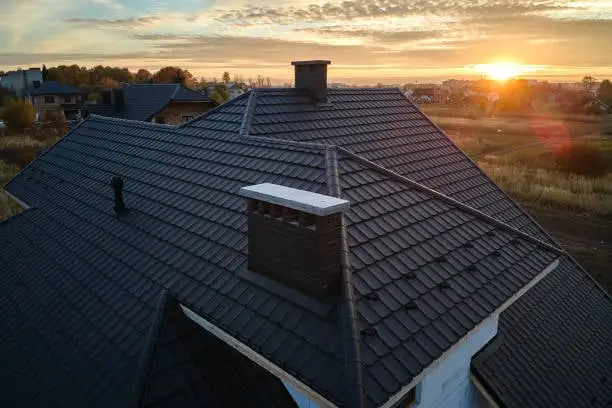
If your estimate lists “replace flashing” and “repair fascia,” it describes work in two different places. Flashing keeps water out at joints and openings. Fascia is the board you see behind the gutter. Ask your roofer to point out each item in a photo so you can match the roof repair to the estimate.
Flashing
Flashing directs water around openings and joints in the roof, such as the base of a chimney or the spot where a wall meets the shingles. If a quote calls for new flashing, ask which joint it covers.
Fascia
Look at the outside edge of the roof, just behind the gutter. The board running along that edge is the fascia. If the estimate includes fascia repair, ask how much of that board needs work and whether the gutter has to come down for access.
Hip
The “hip” is a common roofing term for the side connection between two separate roof slopes. It runs from the top ridge to the eaves. Hip roofs often require additional shingles to protect the long, angled connection.
Valley
A valley is the inside angle where two roof slopes meet. Rain from both slopes drains through it. This is the easiest way to distinguish a valley from a hip when reading an estimate. A valley collects water while a hip sheds it to either side.
Ridge
The ridge represents the horizontal line running across the entire top of the roof, where two roof planes meet. The convergence point of the roofs also creates the highest point, often referred to as the peak.
Gable
A gable remains a very common roofing term and creates a decorative flair to homes with roofs that slope in opposite directions. It forms a triangle at the top of a home’s sidewall, where it joins the end of a roof’s ridge.
Frieze Board
A frieze board sits at the top of a home’s siding and creates a transition either between the soffit and the siding or between two different sidings. Together with the soffit, it forms a corner under the eaves.
Soffit
A soffit refers to the decorative underside of an eave to give it a finished appearance. A soffit can serve as the bottom of a balcony, an arch, or overhanging eaves of a roof. It protects the rafters from the elements while adding to the aesthetic appeal of the house. Soffits can suffer damage from sun and rain and need replacing to prevent them from crumbling.
Drip Edge
Drip edge is the metal trim along the roof perimeter. Its bent lip directs runoff away from the fascia. An estimate may list both drip edge and fascia because the metal trim and the board behind it are separate pieces.
Decking
Decking, also called sheathing, is the surface beneath the underlayment and shingles. On many homes it is plywood or oriented strand board. If the estimate includes a price per sheet, ask how the contractor will document damaged decking and get your approval before replacing it.
Truss
Trusses result from centuries of engineering to support and supplement the rafters of a home. Once erected, homeowners should not alter their trusses because they bear much of the roof’s weight.
Questions about a roof repair in Plant City, Lakeland or Wesley Chapel?
Call True Roofers at (813) 800-1800 or request a roof inspection. If you already have an estimate, tell us which line item you want to understand and where on the roof the contractor found the damage.
